
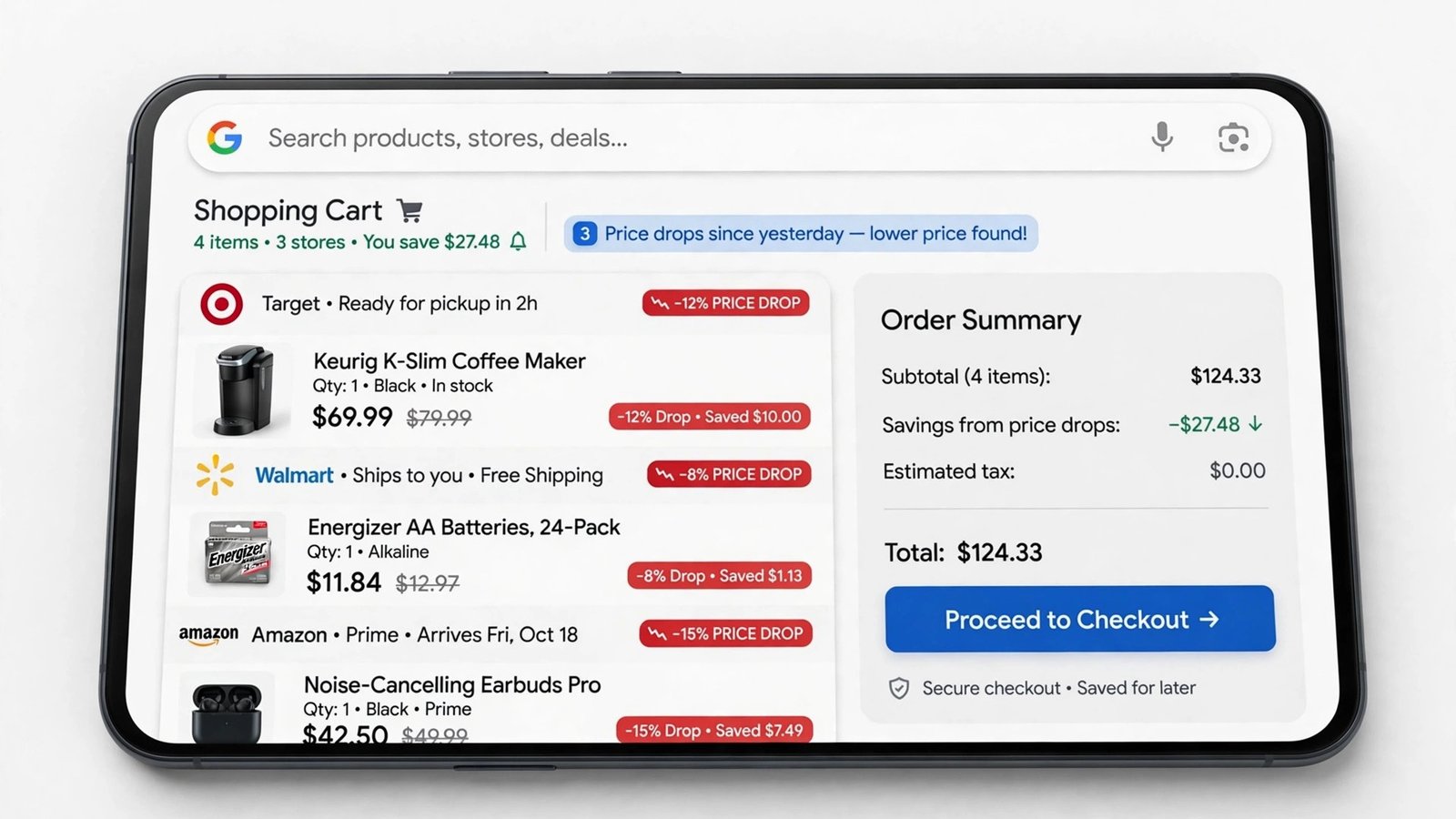
Google launched Universal Cart in the United States on October 15, 2026. It is one shopping cart that follows you across Google Search, AI Mode, and the Gemini app, so products you save in one place show up in the same cart everywhere else on Google. It watches prices, flags restocks, surfaces promo codes, and lets you check out with Google Pay — or hand the items back to the merchant’s own checkout.
That’s the short version. The longer version matters more, because Universal Cart is not really a cart. It is Google’s opening move in a much bigger shift: shopping that happens inside AI conversations instead of on store websites. If you buy things online, it will change how you hunt for deals this holiday season. If you sell things online, it will change how customers find you — whether you signed up for it or not.
What Universal Cart actually is
Universal Cart is a persistent, cross-retailer shopping cart that lives inside Google’s own surfaces. Google first previewed it at Google I/O in May 2026 and flipped it on for US users on October 15, 2026, just ahead of the holiday shopping rush. It works in Google Search (including AI Mode) and in the Gemini app. It does not yet work in YouTube or Gmail, although Google has said it plans to connect those surfaces later. There is no announced timeline for that expansion, and no international rollout date either — for now, this is a US-only feature.
Here’s the example Google itself uses. You save a handbag from Steve Madden while browsing in AI Mode in Search. Later, in the Gemini app, you save a sweater from Quince and lip gloss from Ulta Beauty. When you come back, all three items sit in the same cart. No open tabs. No screenshots of products you meant to come back to. No starting over because you switched apps.
That sounds small. It isn’t, because the cart is the visible part of something much larger underneath: the Universal Commerce Protocol, or UCP, an open standard Google co-developed with Shopify that lets AI agents and merchant systems talk to each other about products, carts, and checkout. The cart is the wrapper. The protocol is the play.
The four things Universal Cart does
Google describes four functions. Each one is worth understanding separately, because each one replaces a habit you already have.
1. One cart across retailers and Google surfaces
The core idea is persistence. Products saved from multiple retailers live in a single cart that follows you across Google Search, AI Mode, and Gemini. Your progress is saved, so you can pick up where you left off days later.
Before this, every store had its own cart, and carts didn’t talk to each other. You compared a jacket at one store to boots at another by juggling tabs, and if you closed the browser, half your research vanished. Universal Cart turns that scattered process into one list. For holiday shopping — gifts for five people from six stores — that alone is a real time saver.
One honest limitation: the cart only sees what you save inside Google’s surfaces. If you browse directly on a merchant’s website, those items don’t feed the same cart. Universal Cart organizes the shopping you do through Google, not all shopping everywhere.
2. Price-drop and back-in-stock alerts
The cart runs on Google’s Shopping Graph, which the company says holds more than 60 billion product listings refreshed continuously. Because the cart knows what you’re watching, it can notify you when a saved item drops in price or when an out-of-stock item comes back.
This is the feature with the most direct money value. Price tracking used to mean installing a browser extension, signing up for a deal-alert site, or just checking back manually. Now it is built into the cart itself. The practical move: save items early, even if you’re not ready to buy. A wishlist that watches prices for you is worth more than a wishlist that just sits there.
How well the alerts work in practice remains to be seen — this is a brand-new rollout, and real-world reliability (how fast alerts fire, whether every retailer participates, whether sale prices trigger correctly) will only become clear as holiday shoppers stress-test it. Treat the alerts as a helpful signal, not a guarantee you caught the lowest price of the season.
3. Card perks and promo codes, surfaced automatically
Universal Cart is built on Google Wallet, so it understands the perks on the credit cards you have saved and can help you choose between payment methods. If one of your cards earns extra points at a particular store, the cart can point that out instead of leaving you to remember it.
It also surfaces relevant promo codes right in the cart. That last part is a quiet threat to an entire industry. Coupon and deal sites exist because finding a working promo code takes effort. If Google finds and applies codes automatically, a lot of shoppers will never visit a coupon site again. Google’s own commentary at the May preview prompted exactly that question from analysts: if the cart finds the best deals itself, why would anyone hunt for them elsewhere? The honest answer is that it depends on coverage — promo codes only help if the merchant participates and the code actually works at checkout. Coupon sites aren’t dead yet, but their reason to exist just got weaker.
4. Checkout through Google Pay, or hand-off to the merchant
When you’re ready to buy, you have two options. You can pay with Google Pay in a few taps with participating stores right in the cart, or you can transfer your items directly to the merchant’s cart and finish buying on their site. Both routes run on the Universal Commerce Protocol.
The participating stores Google named at launch include Nike, Sephora, Target, Ulta Beauty, Walmart, Wayfair, and many Shopify merchants. That list will grow, but not every store supports in-cart checkout yet — for many retailers, the hand-off option is what you’ll actually use.
One detail that matters more than it sounds: the merchant remains the seller of record. You get order confirmations and customer support from the merchant, not from Google. If something goes wrong with shipping, a return, or a defective product, you deal with the store. Google is the interface; the store is still the business you bought from.
How to use Universal Cart
There is no app to install and no separate sign-up. If you are in the US and the rollout has reached your account, it works like this:
- Shop normally inside Google. Browse products in Google Search, ask about products in AI Mode, or shop conversationally in the Gemini app.
- Save items to the cart. When you see a product you like, add it to Universal Cart instead of (or in addition to) the retailer’s own cart.
- Let it watch. Leave items in the cart while you decide. Price-drop and restock notifications come to you automatically.
- Check the savings before you buy. Look at the promo codes the cart surfaces and the card-perk suggestion from Google Wallet. Compare: is the suggested card actually your best one for this store? Google’s suggestion is a starting point, not a final answer — it only knows about the cards you have saved in Wallet.
- Choose your checkout. Pay in-cart with Google Pay at participating stores, or transfer the items to the merchant’s cart to finish on their site. If you want the merchant’s loyalty points, a store-specific return policy, or a coupon the cart didn’t find, the hand-off route is usually the safer choice.
A useful habit for holiday shopping: build the cart early, then wait. Prices on many products dip and bounce through November, and a cart full of saved items with alerts on is the lowest-effort way to catch a dip without living on deal sites.
What it means for shoppers: the real upsides
The convenience case is genuine. Shopping today is fragmented by design — every store wants you inside its own walls, with its own account, its own cart, its own checkout. Universal Cart pushes back against that fragmentation from the shopper’s side. One list, one place, automatic price-watching, and fewer forms.
The savings case is real but modest. Promo codes and card-perk suggestions might save you a few dollars per order. Price-drop alerts might save you more if you’re patient and the item actually drops. Nobody should expect Universal Cart to magically cut their holiday bill in half. The honest math is small, repeated wins: a code here, a better card choice there, a price dip you would have missed.
The comparison case is the one to watch. Because the cart holds items from competing stores side by side, it makes price and availability differences visible in a way that separate carts never did. That transparency favors shoppers — and it pressures retailers to compete on price, delivery speed, and availability, which are exactly the things an AI assistant uses as tiebreakers when products look similar.
What it means for sellers: the cart is the least of it
If you run a store, Universal Cart itself is not the thing to worry about. The protocol underneath it is.
UCP — the Universal Commerce Protocol — is an open standard, co-developed by Google and Shopify and backed by companies including Amazon, American Express, Etsy, Mastercard, Meta, Microsoft, Salesforce, Stripe, Target, Walmart, and Visa. It defines how AI agents discover products, negotiate checkout terms, and complete transactions with merchants. It launched in January 2026 under the Apache 2.0 license and is already wired into Google AI Mode, the Gemini apps, and Microsoft Copilot Checkout.
For a small or mid-size seller, the practical consequences break down like this:
Product data is now a competitive asset, not a chore. When an AI agent is choosing what to show a shopper, it works from structured product data — titles, descriptions, images, prices, availability, shipping windows, GTINs and SKUs. Clean, complete, accurate feeds win. Thin listings with missing sizes, vague descriptions, or stale prices lose, because the agent has no reason to recommend what it can’t understand. If you sell on Shopify, much of this flows through Shopify Catalog and the Agentic Storefronts channel, which is active by default for eligible stores and managed under Sales channels, then Agentic, in the Shopify admin. If you sell on WooCommerce or another platform, the same principle applies: your feed quality is now part of your marketing.
Discovery is shifting from “win the click” to “win the agent’s consideration set.” Retail experts who weighed in at launch made this point bluntly: the merchant keeps the transaction, the data, and the customer relationship on paper, but discovery, comparison, and the decision increasingly happen inside Google’s surface. In plain terms, the shopper may never visit your site at all — they may discover your product, compare it, and buy it inside Google. That means your product has to be findable and recommendable by machines, not just appealing to humans who land on your homepage.
You don’t need to build a custom integration for every AI surface. That is the whole point of a shared protocol. A UCP-compliant merchant publishes one capability profile, and any compliant agent can read it. When a new AI platform adopts UCP, Shopify merchants are automatically ready to sell there with no additional integration. For small sellers, that is genuinely good news — you get distribution across AI surfaces without hiring a developer for each one.
The merchant of record stays the merchant. This is the part that should reassure sellers: UCP is merchant-centric. Retailers remain the seller of record, control their pricing and business logic, and own the customer relationship. Orders flow into your admin with attribution showing which AI channel drove the sale. You still fulfill, you still handle support, and you still own the customer data.
If you sell digital products or run a small store, the near-term to-do list is short: keep your product feeds accurate and complete, make sure your prices and inventory are current, and check whether your platform already exposes you to AI surfaces by default. If you want the longer version of the fee and platform math behind that decision, our breakdown of WooCommerce 11.2’s October 2026 changes for digital sellers and our Etsy fee math for Q4 2026 cover the numbers side of selling right now.
The honest concerns
Universal Cart is convenient, and convenience always has a price. Here are the concerns worth taking seriously.
Privacy and concentration. One company now maps the products, runs the assistant, and processes the payment. Google sees your entire consideration set across competing stores — what you looked at, what you skipped, what you waited on. That visibility is strategically powerful, and it is the same concentration question that follows every Google product. If you are uncomfortable with Google holding that much of your shopping behavior, the hand-off checkout option and a lighter touch on saved items are the middle path: use the cart for tracking, buy on the merchant’s site.
Small retailers and the price race. When an AI assistant compares five similar products, it reaches for the cleanest tiebreakers: price, delivery speed, reviews, availability. Commodity sellers — the ones selling batteries, shampoo, pet food, beauty basics — are the most exposed, because there is nothing to differentiate on except price. Differentiated brands with strong reviews, clear product content, reliable availability, and a real repeat-purchase relationship have more for the AI to work with than price alone. But brands that spent years optimizing their sites for cross-sells and upsells lose something real when the shopper never visits the site. The running-shoe store that used to sell you socks with the shoes doesn’t get that chance inside Google’s cart.
Coupon sites and affiliate publishers get squeezed. If Google surfaces promo codes automatically, the coupon aggregators and deal sites that earn affiliate commissions for sending shoppers to codes lose traffic. Google has not said how promo-code attribution works inside the cart, and that is a live question for publishers who make money from deal content. Our earlier coverage of Google’s AI answer payments pilot for publishers covers the broader version of this same tension: as answers and carts move inside AI surfaces, the publishers who used to get the click need a new deal.
Ranking and fairness are still a black box. How does Google decide which products to show, and in what order, inside AI Mode and Gemini? What happens when a merchant’s price in the Shopping Graph is stale? Early reactions from marketers have flagged exactly these questions, and Google has not published a ranking formula. Sellers should assume the system rewards accurate, complete, well-reviewed listings — and verify their own listings look right inside Google’s surfaces rather than assuming they do.
It is a rollout, not a finished product. Google’s own launch language says “rolling out.” Some accounts will see it before others. YouTube and Gmail integration is promised but undated. International availability is “coming months” for Canada, Australia, and the UK, with no mention of Europe. Treat any claim that Universal Cart does X everywhere as premature until you’ve seen it in your own account.
Universal Cart vs. the alternatives
Google is not the only company building AI shopping. The competitive picture matters because it tells you where this is heading:
- Amazon has its own AI shopping features and, obviously, the deepest fulfillment network. But Amazon’s cart only holds Amazon products. Universal Cart’s whole pitch is that it is cross-retailer.
- OpenAI’s ChatGPT launched Instant Checkout in September 2025 using its Agentic Commerce Protocol (ACP) with Stripe, then scaled it back in March 2026 so merchants use their own checkout while ChatGPT focuses on product discovery. ACP and UCP are sibling standards with different governance — UCP is the Google/Shopify one, ACP is the OpenAI/Stripe one. Both keep the merchant as seller of record.
- Shop Pay and Apple Pay already offer fast checkout, but they don’t organize your shopping across stores or watch prices for you. They solve the payment step; Universal Cart tries to own the whole journey from discovery to purchase.
The pattern is consistent: every major platform wants to be the layer between you and the store. Universal Cart is Google’s version. Expect the others to keep pushing, and expect the protocols — not the carts — to decide who wins.
Should you use it? A quick decision guide
Use it if: you shop across multiple stores, you buy gifts for several people at once, you like deal-hunting but hate the effort, or you carry multiple credit cards and never remember which one earns the most at which store.
Skip it (for now) if: you do nearly all your shopping on one or two sites, you are uncomfortable with Google seeing your full shopping behavior, or you rely on a merchant’s loyalty program and want every purchase to count there. You can always use the cart for tracking and check out on the merchant’s site instead.
If you sell things: check your product feeds this week. Make sure titles, descriptions, images, prices, and availability are accurate and complete. Find out whether your platform already exposes you to AI surfaces. And keep an eye on where your orders come from — if AI-referred orders start showing up in your admin, track them separately so you can judge them on margin, not just volume.
The bottom line
Google Universal Cart, launched October 15, 2026, is a genuinely useful tool for shoppers: one cart across Search, AI Mode, and Gemini, with price-drop alerts, restock notifications, promo codes, and card-perk suggestions built in. It is free, it is US-only for now, and the merchant still handles your order.
But the cart is the wrapper. The real story is the Universal Commerce Protocol underneath it — an open standard that lets AI agents shop on your behalf across any store that speaks it. That is the infrastructure that will decide how online shopping works over the next few years, and it is already live. Whether you buy or sell, the smart move is the same: try it with real purchases, watch what it gets right and wrong, and don’t assume the old way of shopping — tabs, screenshots, and a cart on every site — is coming back.
Frequently Asked Questions
Is Google Universal Cart free to use?
Yes. There is no fee to save items, receive price-drop or restock alerts, or check out through the cart. You pay the merchant’s price for the products you buy, and any shipping or taxes the merchant charges still apply. Google does not add a surcharge for using the cart.
Which stores work with Universal Cart?
At launch, Google named Nike, Sephora, Target, Ulta Beauty, Walmart, Wayfair, and many Shopify merchants as places where the simplified checkout can be tried. The cart can save products from many more retailers, but in-cart checkout with Google Pay is only available at participating stores. For other stores, you can transfer items to the merchant’s own cart and finish buying there.
Does Universal Cart work outside the United States?
Not yet. The October 15, 2026 launch is US-only, across Google Search and the Gemini app. Google has indicated Canada, Australia, and the UK are expected in coming months. Europe was not mentioned in the launch roadmap.
Who handles returns and customer support for Universal Cart orders?
The merchant does. The merchant remains the seller of record, so order confirmations, shipping, returns, and customer support all come from the store you bought from — not from Google. If something goes wrong, contact the merchant first, just as you would for any other online order.
Does the merchant still own the customer relationship?
According to Google and the UCP design, yes. Retailers remain the merchant of record, control their pricing and business logic, and own the customer relationship. Orders flow into the merchant’s system with attribution showing which AI channel drove the sale. The open question is influence: discovery and comparison happen inside Google’s surface, so merchants get the transaction but less control over the moment of choice.
Can I use Universal Cart and still earn my store loyalty points?
It depends on the store and the checkout route. If you transfer items to the merchant’s cart and check out on their site, your normal loyalty program should work as usual. If you check out inside Google’s cart with Google Pay, loyalty earning depends on whether that merchant’s program is connected. When loyalty points matter to you, the hand-off route is the safer choice.